
Criminal Cases in Twin Falls County Courts
Twin Falls County is part of Idaho's Fifth Judicial District. District Court handles felony trials and sentencing. The Magistrate Division hears misdemeanors and infractions, as well as the first stages of felony matters, including the preliminary hearing that tests whether enough evidence exists to continue. A complaint may begin a case, while an information is the prosecutor's formal charging document. Those terms describe different filings, not different databases.
The Clerk of District Court keeps the judicial file at 630 Addison Avenue West in Twin Falls. The clerk's main line is 208-736-4004, and District Court is listed at 208-736-4025. Court staff can route a request for an older file, a document not available online, or a certified copy. The clerk does not keep the police narrative or the jail booking file. Those remain with the arresting agency and sheriff.
Twin Falls Criminal Court Divisions
The division shown on a Twin Falls criminal case tells the reader where the matter is in the local process. A felony can first appear before a magistrate for an initial appearance and preliminary stage, then proceed in District Court after formal filing. Misdemeanors and infractions generally remain in Magistrate Division. Reading the division with the case status prevents a common mistake: treating a preliminary felony entry as a final felony judgment.
The Twin Falls County court office supplies local clerk routing. Use the statewide docket for the event history, but contact this office when the online view does not expose the document needed. Court personnel can explain access procedures, though they cannot provide legal advice or interpret what an order means for a party.
How to Search Case Records
Idaho iCourt is the main remote search for Twin Falls County criminal case records. A name or exact case number is the best starting point. Advanced criteria may include party name, date of birth, case status, category, and filing dates. The interface changes, and some controls were not exposed in its text view during research, so verify the labels shown on the live screen. Basic case information is free; access to particular documents can differ.
- Open iCourt and enter a party name or the displayed case number.
- Limit the location to Twin Falls and select a criminal category when that filter appears.
- Use date of birth or a filing range to separate people with similar names.
- Open the matching docket and read every charge and register entry separately.
- Ask the county clerk for unavailable, older, or certified documents.
| Field Label | Type | Required | Notes |
|---|---|---|---|
| Search Criteria | Text | Unspecified | Name or record/case number |
| Party Name | Text | Optional | Advanced field; confirm identity with DOB |
| Case Number | Text | Optional | Use the exact displayed format |
| Date of Birth | Date | Optional | Helps narrow common names |
| Status, Type, Filing Dates | Filters | Optional | Options depend on the live interface |
The official iCourt search is shown in the state court portal.
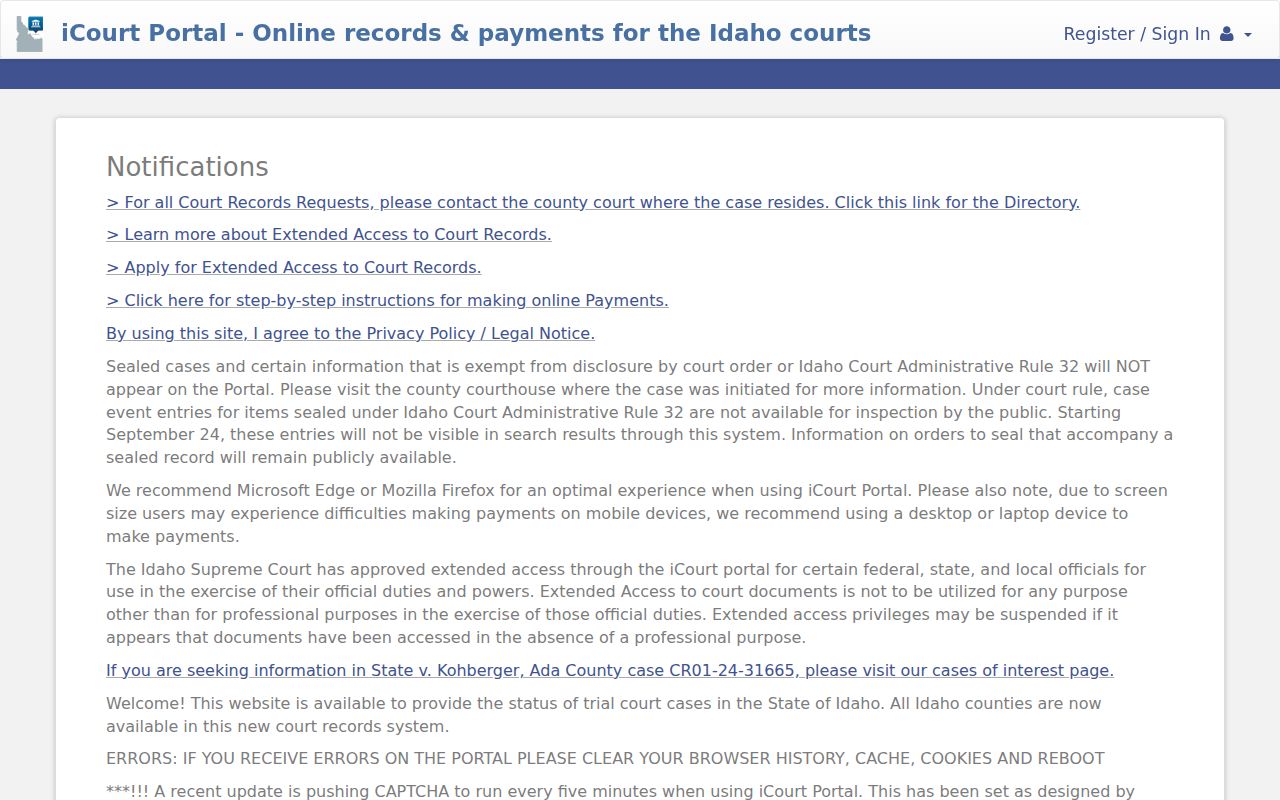
The portal image identifies the statewide starting point, but the docket must still be narrowed to Twin Falls and matched by more than a name alone.
Twin Falls Court Documents Offline
A docket entry and its underlying document are not the same thing. iCourt may show that an order, judgment, or filing exists while withholding the image from remote view. The Idaho Courts records guide directs readers to iCourt first, then to courthouse kiosks or the clerk for material that is not online. Ask for the case number, document title, and filing date when possible. That detail reduces the risk of ordering the wrong item.
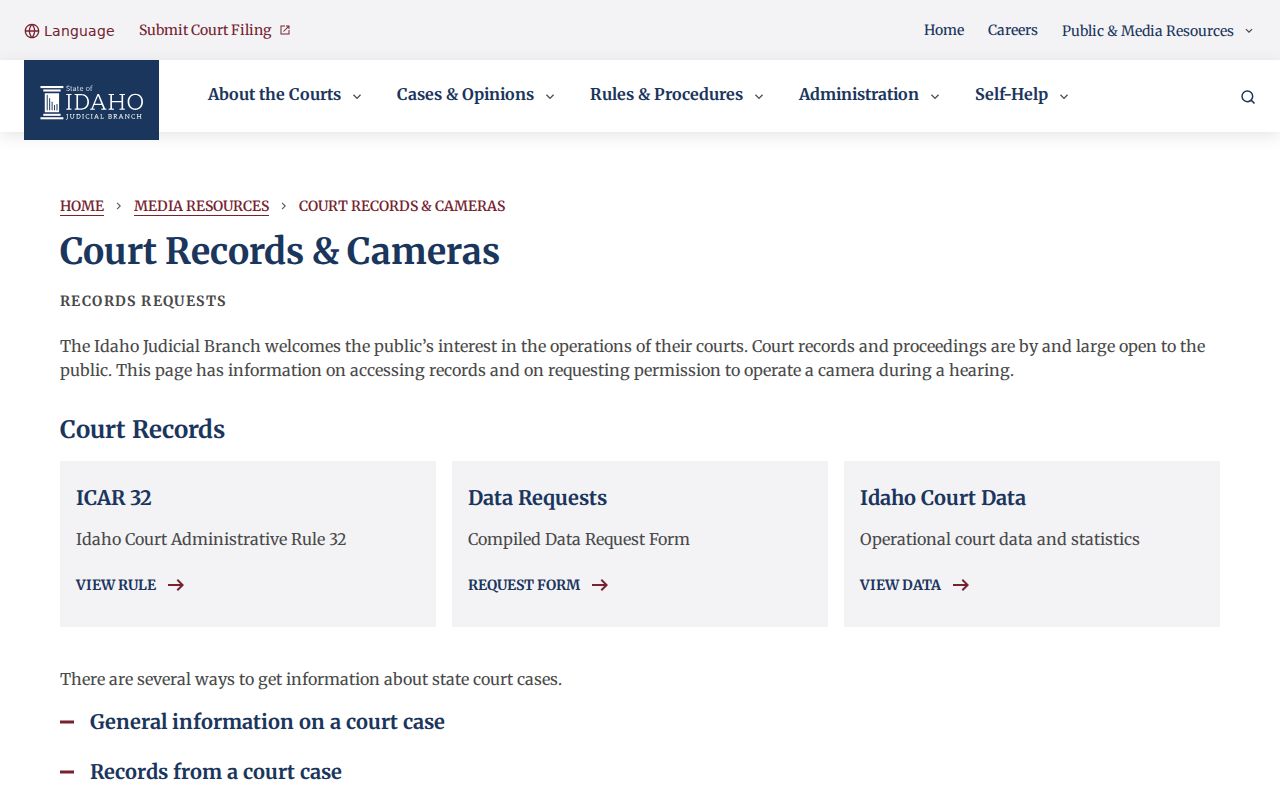
The guide reinforces the two-tier access route: search the index remotely, then use the clerk or kiosk for documents that require local access.
If the search produces no result, test spelling, aliases, date filters, and the county selection before concluding that no case exists. A police report with no filed prosecution will not become an iCourt case. Likewise, a sealed or restricted matter may not appear in the public index.
What the Case File Shows
A public Twin Falls case file can show the caption, number, court, filing date, parties, charges, hearings, chronological register of actions, disposition, orders, judgment, and public financial entries. The register is a dated list of events. It helps establish what happened and when, while the filed order supplies the court's exact ruling. Some documents need clerk or kiosk access, and protected information is redacted.
| Case Number & Court | Identifies the matter, location, and trial-court division. |
|---|---|
| Charging Document | States the allegations filed by complaint, information, or indictment. |
| Docket Entries | Lists filed papers and court events in date order. |
| Hearing Dates | Shows public dates, times, and locations when available. |
| Disposition & Judgment | Records each charge's result and the formal decision. |
| Sentence & Conditions | Shows punishment and public conditions after conviction. |
Read Twin Falls Case Outcomes
Charges must be read one by one. A case can contain a conviction on one count and a dismissal on another. “Disposition” means the outcome of a charge. A dismissal ends that charge without a conviction, yet the docket can remain visible with the dismissal recorded. An acquittal is a not-guilty result after adjudication. Neither should be described as a conviction.
The arrest allegation may also differ from the prosecutor's filed charge. Compare the sheriff record with iCourt rather than forcing the two to match. If a final outcome is absent from a repository record, obtain the court disposition and follow the Idaho Bureau of Criminal Identification correction process. BCI changes repository data only with direction or authority from the originating agency or court.
Stages of a Criminal Case
A Twin Falls criminal matter can begin with an arrest or summons, followed by a complaint and initial court appearance. A magistrate handles the early felony stage, including a preliminary hearing when required. The prosecutor may then file an information in District Court. Misdemeanors generally remain with the Magistrate Division. A plea, dismissal, trial result, or other ruling produces the disposition. A conviction is followed by judgment and sentence.
Case flow: Arrest › Booking › Charges › Arraignment › Disposition › Sentencing
This line is a map, not a promise that each case uses every stage. Some defendants receive a summons rather than a jail booking. Charges can be dismissed before trial, and plea agreements can resolve a matter without a trial. Read the actual register instead of assuming the next event.
Twin Falls Arraignment Report Limits
The Sheriff's weekday arraignment PDF concerns scheduled jail arraignments. It is useful for a recent custody event, but it is not the authoritative court calendar and does not replace iCourt. A listing can reflect the timing of a jail appearance, while the court docket carries filed charges, later hearings, orders, and final disposition. Weekend and holiday publication schedules can also create a delay.
The local court source is the Twin Falls County clerk and courts page.
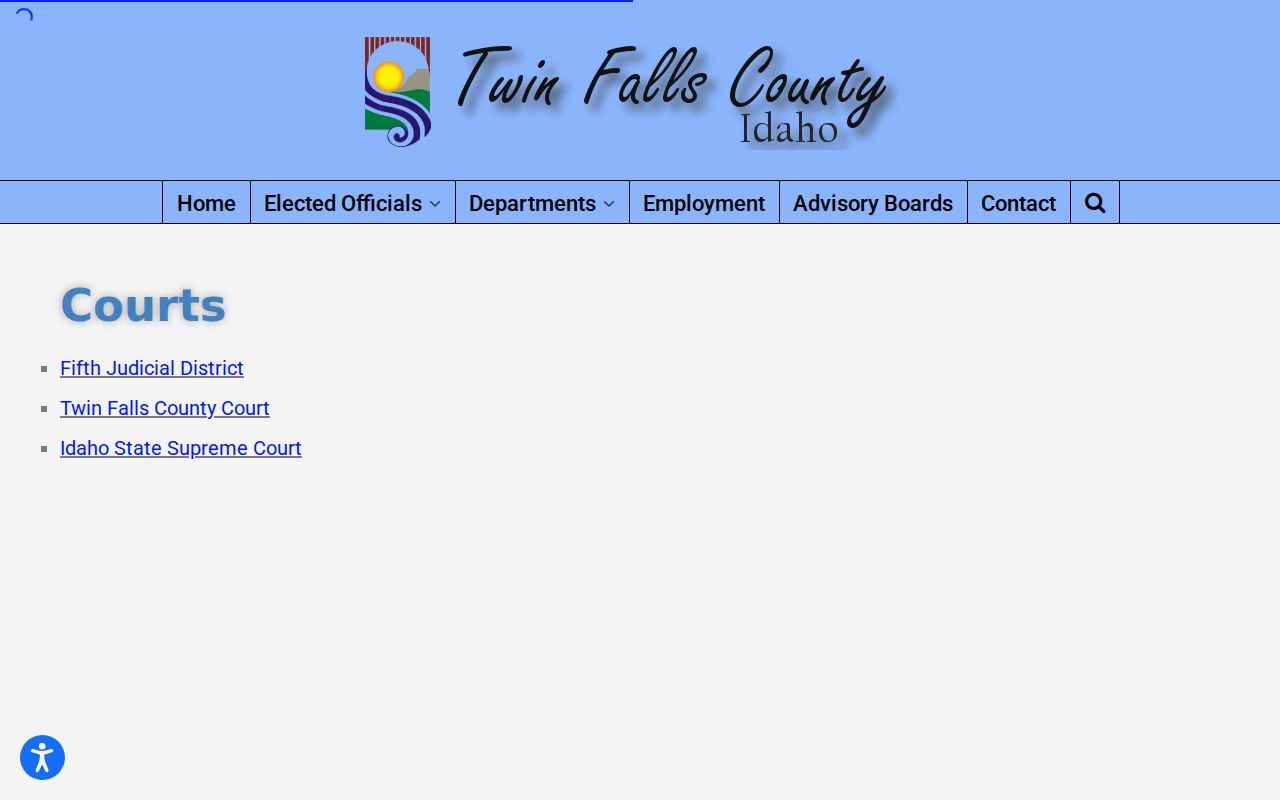
This county source is the correct fallback when the statewide interface does not provide the needed filing or when a certified court copy is required.
Twin Falls Case Number Confusion
Local justice records use several identifiers that should not be swapped. The iCourt case number identifies the judicial matter. A sheriff jacket number identifies a person within the jail record system. An OCA or case number on the active-warrant PDF helps identify the warrant entry, while an IDOC number belongs to the state corrections record. Copy the identifier exactly and note the system that displayed it. That small step keeps a clerk request from being routed by a jail number that the court cannot use.
When linking an arrest to a case, compare the person's name, date of birth where public, filing timing, court location, and charge description. Do not assume that similar allegations or matching names establish identity. The warrant list can lag after service or withdrawal, and a booking allegation can change before formal filing. The court's case number and current docket are the sound reference for court status.
A court record is also distinct from a BCI criminal-history record. BCI organizes fingerprint-linked arrest cycles and reported outcomes at the state level. iCourt supplies the richer local judicial chronology. If one source lacks a disposition, obtain the certified court result and use the repository's correction route rather than assuming the case is still pending.
Access & Restrictions
Idaho Court Administrative Rule 32 governs public access to court indexes, calendars, chronological summaries, filed documents, orders, and judgments. It also protects categories such as juvenile material, victim or minor identifying data, financial account numbers, medical information, and other restricted content. Presentence investigation reports are presumptively sealed. A public online view may therefore contain less detail than the case file.
A party or affected nonparty may ask the court to redact or seal material. The judge must use the least restrictive protection and make the findings Rule 32 requires. A sealing order remains public even when the protected material does not. If a case is missing, ask the clerk whether the issue is search criteria, document availability, archive access, or a legal restriction. Do not treat an empty online result as proof that no record exists.